7 Classroom Drawing Icebreakers That Get Every Student Involved
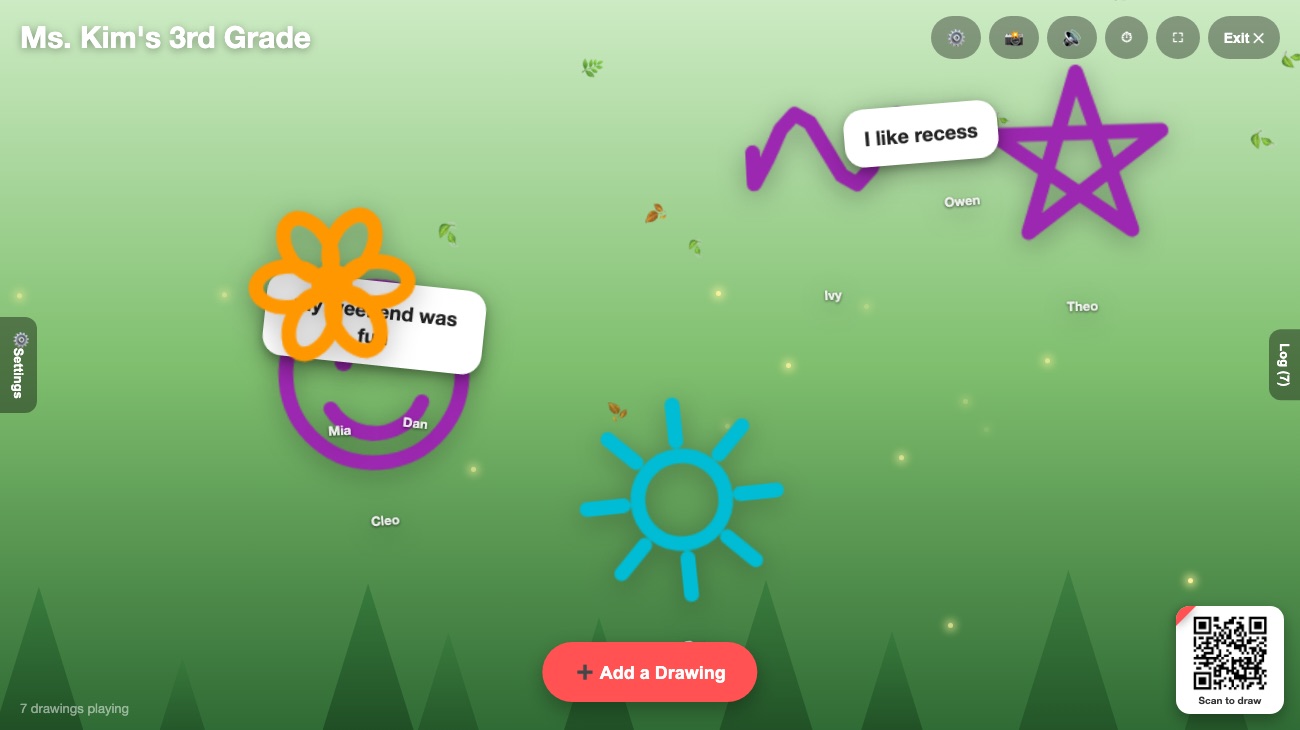
A real-time drawing wall gives every student a voice at once — even the quiet ones. Because kids draw on their own device and everything appears on the classroom screen together, no one has to raise a hand or come to the front. Here are seven icebreakers you can run in under ten minutes, plus tips for keeping them smooth.
How the setup works
Open Drawing Playground on your classroom projector or smartboard and pick a theme. A QR code appears; students scan it with their own device and a drawing canvas opens in the browser — no app to install and no logins to manage. Their drawings float onto the shared screen the moment they send them. Nothing is saved to a server after the session, which keeps things simple and private for a school setting.
💡 No 1:1 devices? Put students in pairs or small groups around a few tablets. Drawing takes only a few seconds, so devices rotate quickly.
1. Draw how you're feeling today
A gentle morning check-in. Ask students to draw a face, weather symbol, or emoji that matches their mood. As the wall fills, you get an instant, low-pressure read on the room — and students who'd never say "I'm nervous" out loud will happily draw a rain cloud. Great for social-emotional learning without putting anyone on the spot.
2. Two-minute vocabulary sketch
Call out a word from your current unit — "habitat," "fraction," "erosion" — and give students two minutes to draw their understanding of it. The variety on screen becomes an instant discussion starter: "Why did some of you draw a forest and others draw a fish tank?" It turns a definition into a conversation.
3. Guess the story
After a read-aloud, ask each student to draw their favorite moment. Project the wall and have the class guess which scene each drawing shows. It rewards close listening and gives you a quick, visual comprehension check across the whole class at once.
4. Collaborative class monster
Assign a body part to different rows or groups — heads, arms, legs, tails — and have everyone draw their piece. On the wall, the mismatched parts become one gloriously chaotic class creature. It's a lesson in how a group can build something together, and it never fails to get a laugh.
5. Would-you-rather in pictures
Pose a "would you rather" question and have students answer by drawing rather than speaking — "Would you rather visit space or the deep ocean?" Pair it with the Space or Ocean theme so the answers land right on the matching background. A fun way to practice reasoning and see the class split in real time.
6. Exit-ticket doodle
In the last five minutes, ask students to draw the one thing they'll remember from today's lesson. Save a snapshot of the wall to your device before ending the session and you have an instant record of what stuck — useful for planning tomorrow's warm-up or spotting a concept that needs another pass.
7. Silent brainstorm
Before starting a new topic, ask "What do you already know about volcanoes?" and let students flood the wall with drawings and short labels. Because it's silent and simultaneous, you capture ideas from thirty students in ninety seconds — including from kids who never volunteer answers aloud.
Tips for a smooth classroom session
- Set the norm first. Remind students the wall is for the lesson, and that you can see and remove any drawing from the big screen. A one-line expectation keeps things on track.
- Use the pause control. When you want the class's eyes up front, pause new drawings so the screen holds still while you talk.
- Keep prompts specific. "Draw a plant cell" produces better focus than "draw something from science."
- Timebox it. Two to three minutes per round keeps energy high and transitions crisp.
🔒 For school privacy: students don't create accounts or enter personal information, and the optional name field isn't linked to any identity. Drawings live only in memory during the session. See our Privacy Policy.